








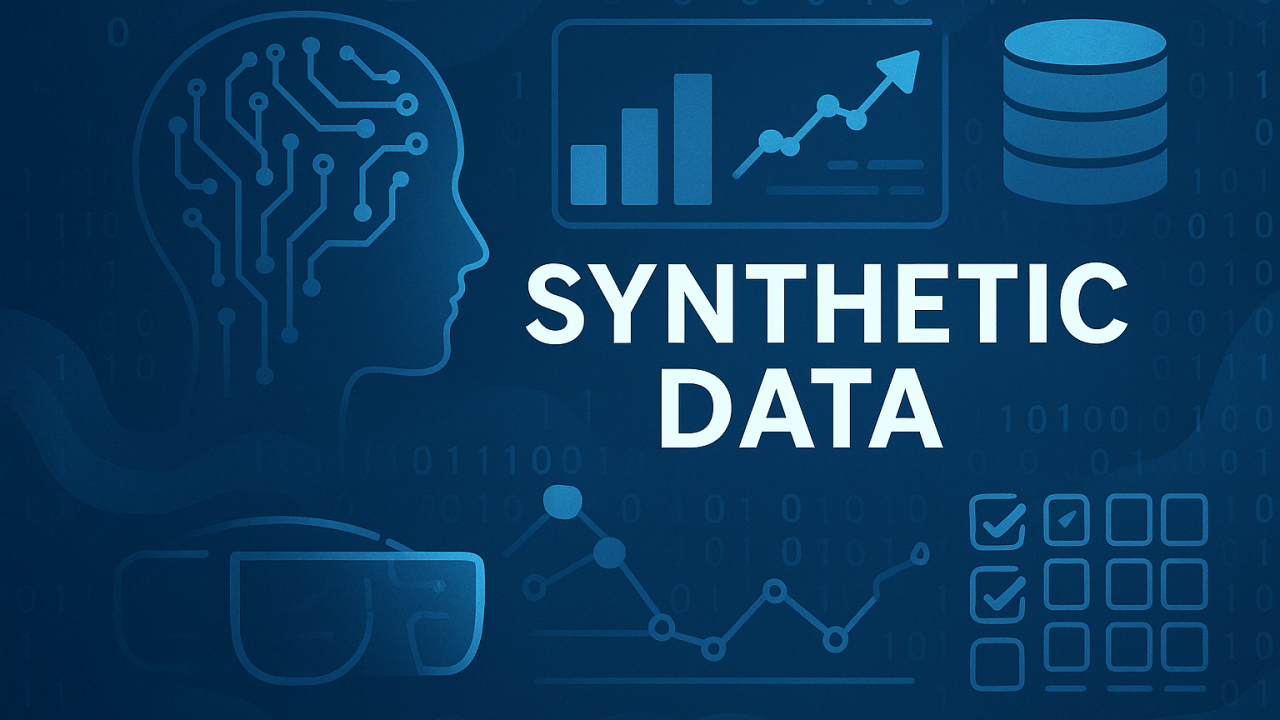
The next fight in artificial intelligence is not only about chips, cloud bills, or who has the biggest model. It is about usable data. AI Training Data has become harder to gather at the same moment companies want smarter systems for health care, finance, robotics, customer support, and national security. Public web access is shrinking, privacy rules are tighter, and the richest business records often sit locked inside legal or compliance walls. Researchers tracking AI scaling have warned that high-quality human-written text may become a real limit, while audits show more web sources restricting crawler access for model builders.
Synthetic data generation does not remove the need for real records. That is the mistake many teams make. It creates controlled practice material when the real world is too slow, too risky, too private, or too rare to supply enough examples. For U.S. companies watching this shift through technology and business coverage, the smart question is not “Can fake data replace real data?” It cannot. The better question is, “Where can artificial examples help a model learn what real records fail to show often enough?”
Why Real-World Data Alone No Longer Covers the Job
Real-world data sounds clean and honest until you try to build a system with it. Then the cracks show. Customer records are incomplete. Medical notes are messy. Factory sensor logs skip the moment when a machine fails. A bank may have millions of normal transactions but far fewer fraud cases. The dataset looks large, yet the useful part may be thin.
That gap is the heart of data scarcity in AI. The shortage is not always about total volume. It is often about the right mix of situations. A model that sees 10 million easy cases and 400 hard ones may still fail when the hard case appears in public, at scale, and under pressure.
The web is getting smaller for builders
For years, many AI labs treated the open web like an endless warehouse. That era is fading. Publishers, forums, universities, artists, software communities, and media owners are asking harder questions about consent and payment. Some block crawlers. Some change terms. Some place useful material behind gates.
That matters because public text helped shape many general-purpose models. When better sources become harder to access, the leftover pool can tilt toward lower-quality pages, repeated content, spam, or content written by other machines. A bigger crawl does not always mean a better crawl.
A U.S. startup building a legal assistant can feel this fast. Court opinions may be public, but annotated attorney work product is not. Client memos are private. Settlement reasoning is buried in closed files. Without careful access, the model learns law as public language, not as working legal judgment.
Scarcity shows up first in edge cases
The first failures rarely happen in the average case. They happen at the edge. A self-driving system may see endless clear-lane highway footage and still struggle with a construction worker waving traffic around a flooded underpass in Houston. A hospital model may read routine discharge notes well and still miss a rare medication conflict in an elderly patient.
That is where synthetic datasets become practical. They can add rare conditions, strange combinations, and stress cases that would take years to collect naturally. The point is not to invent a fantasy world. The point is to ask, “What would the model need to see before we trust it near people?”
A quiet truth sits here: rare examples are often more valuable than common ones. One well-made crash scenario, fraud pattern, or emergency-room corner case can teach more than thousands of plain records. Volume gets attention. Coverage wins.
Where Synthetic Data Generation Technology Helps AI Training Data Gaps Most
Synthetic examples work best when they are aimed at a known shortage. They are weaker when teams create them in bulk and hope size alone fixes the model. Good synthetic work starts with a map of what is missing, then builds examples to fill those holes.
This is where Synthetic Data Generation Technology Solving AI Training Data Shortage Problems becomes more than a headline. The value sits in targeted design. A team can create balanced examples for rare claims, unusual medical paths, unsafe driving scenes, speech accents, product defects, or security attacks without waiting for enough real cases to appear.
Rare events without waiting for rare accidents
Some events are too dangerous or too slow to collect in the wild. Aviation, autonomous driving, industrial safety, and emergency response all face this issue. You cannot wait for 5,000 near-miss forklift incidents in Ohio warehouses before training a safety model. You create simulations, vary the lighting, alter the floor layout, change worker movement, and test how the system responds.
The same logic applies in insurance. A claims model may have plenty of ordinary roof-damage photos after a storm, but few examples showing subtle fraud. Synthetic images and records can create controlled variants: mismatched shadows, repeated metadata patterns, staged damage, or repairs made before the claimed event.
Synthetic data generation earns its keep when it teaches judgment under pressure. The model sees cases that are possible, costly, and underrepresented. That is not cheating. It is rehearsal.
Privacy-safe practice for locked-down records
Privacy is another reason this field is growing. Health systems, banks, schools, and public agencies often hold useful data they cannot freely share. Even when names are removed, patterns can still point back to people. That risk is not theoretical; NIST has warned that redacted datasets can remain vulnerable when attackers combine clues from other sources.
Differentially private synthetic data offers one path. NIST describes these datasets as keeping the same schema and trying to preserve useful relationships in the original data while adding a privacy guarantee for the people behind it. A hospital, for example, might share artificial patient records for software testing without handing vendors actual patient charts.
This does not mean the data is safe by default. Poorly made synthetic records can still leak patterns, flatten minority groups, or hide bias under a clean label. Privacy-safe does not mean truth-safe. Teams still need review, audits, and limits on where synthetic records can be used.
The Quality Trap Hidden Inside Synthetic Datasets
The biggest danger is not that synthetic examples are fake. Everyone knows that. The danger is that they can look tidy, cheap, and endless. That makes weak data tempting. A team under deadline may generate millions of samples, mix them into model training data, and call the problem solved.
That path can poison the well. Models trained too heavily on machine-made material may become flatter, more repetitive, and less aware of rare patterns. Research on model collapse has found that training only on synthetic data can cause the tails of the original distribution to disappear, which means unusual cases get washed out first.
Model collapse starts when averages crowd out odd cases
Models love patterns. Synthetic generators love patterns too. Put those together without guardrails, and you get a loop where the system keeps feeding itself cleaner versions of what it already believes. The average answer gets stronger. The weird answer fades.
That is bad news because the weird answer is often the one a human needed help with. A regional phrase in rural Alabama. A rare skin presentation in a dermatology image. A financial scam aimed at older Americans. A machine fault that happens only when heat, dust, and a worn belt meet on the same afternoon.
The non-obvious insight is that synthetic data can reduce diversity while appearing to increase it. A dashboard may show more records, more labels, and more balanced columns. Yet the language, timing, and hidden assumptions may come from the same generator. Many rows. One imagination.
Human review still decides what gets trusted
Synthetic data needs editors, not only engineers. Someone has to ask whether the generated examples make sense in the field. A nurse can spot a fake patient timeline that no hospital floor would produce. A claims adjuster can catch a damage pattern that looks dramatic but not plausible. A warehouse manager can tell when a simulated safety issue ignores how people move during a rush shift.
Manual review does not scale neatly, and that is the tension. Researchers studying synthetic data use across AI teams have found that practitioners lean on it across the development pipeline, yet still struggle with output control, underrepresented groups, and validation practices that depend on human inspection.
A good rule is simple: never trust a synthetic dataset because it is large. Trust it because it was designed, sampled, challenged, and tested against real outcomes. Size is a poor substitute for field sense.
How U.S. Teams Should Build a Safer Data Mix
The best teams will not choose between real and synthetic data like it is a culture war. They will build a mix. Real data anchors the model. Synthetic records fill known gaps. Human review catches nonsense. Live testing checks whether the system behaves in the world, not only in a lab.
That mix matters for U.S. businesses because risk lands close to home. A bad hiring screen can reject real applicants. A weak medical triage tool can delay care. A poor credit model can punish families who already face thin-file banking issues. Synthetic data generation must be part of governance, not a side project owned by one machine learning team.
Keep a living map of source, synthetic, and rejected records
Teams need data lineage that people can understand. Each dataset should say where records came from, why synthetic examples were added, what generator created them, what real records guided them, and which tests they passed. That sounds dull. It saves teams later.
A retailer building a demand model for stores in Texas, Florida, and Michigan might create artificial sales weeks to test extreme weather, supplier delays, or sudden viral demand. Those synthetic weeks should be marked clearly. If the model later overreacts to storms, the team can trace whether the artificial examples were too dramatic.
This connects with enterprise data governance checklist work because governance is not paperwork after the fact. It shapes what the model learns. NIST’s AI Risk Management Framework gives organizations a structured way to manage AI risks across design, testing, deployment, and monitoring.
Test against people, places, and failures the lab forgot
Synthetic records can make a model look ready when the test set is too close to the generator. That is why outside checks matter. Teams should test against real regional differences, accents, device types, income patterns, weather conditions, and workflow habits. America is not one market. It is many markets wearing one flag.
A voice assistant trained for customer service may perform well on clean synthetic calls, then stumble when callers use Spanish-English phrasing, older phones, background TV noise, or local slang. A fraud model may catch fake patterns made in a lab but miss scams that spread through church groups, local Facebook pages, or text chains.
The fix is not to abandon synthetic data. The fix is to make it answer to reality. Pair it with responsible AI adoption guide planning, red-team tests, and post-launch monitoring. The model should keep proving itself after release, because the world keeps moving.
Conclusion
Synthetic data is not a shortcut around hard data work. It is a tool for the parts of reality that are rare, private, dangerous, expensive, or locked away. Used well, it can help U.S. companies train models for cases they would never collect in time. Used poorly, it can make systems smoother, shallower, and more confident in the wrong places.
The future of AI Training Data will belong to teams that keep real-world grounding at the center. They will generate examples with purpose, label them honestly, test them against field knowledge, and watch for drift after launch. The winners will not be the companies with the most artificial records. They will be the ones that know which records deserve to exist.
Build the dataset like the model’s judgment depends on it, because it does.
Frequently Asked Questions
What is synthetic data generation in AI?
It is the process of creating artificial records, images, text, events, or scenarios that resemble real data without copying actual records one-for-one. Teams use it to train, test, or evaluate models when real examples are limited, sensitive, costly, or hard to collect.
Is synthetic data better than real data for machine learning?
No. Real data gives the model grounding in actual behavior, mistakes, timing, and context. Synthetic examples are best used to fill gaps, balance rare cases, or test risky situations. A strong system usually needs both, with clear tracking of each source.
How does synthetic data help with data scarcity in AI?
It gives teams controlled examples of events that do not appear often enough in real records. That can include rare fraud, uncommon medical cases, unusual driving scenes, or equipment failures. The value comes from targeted coverage, not from creating endless artificial volume.
Can synthetic datasets protect customer privacy?
They can help, especially when built with privacy methods such as differential privacy. Still, they need testing. Weak synthetic records may leak patterns from the source data or create false confidence. Privacy review, access limits, and audit trails should stay in place.
What industries use synthetic data generation the most?
Health care, finance, autonomous vehicles, retail, cybersecurity, insurance, robotics, and public-sector technology all use it. These fields often face rare events, sensitive records, or safety risks that make direct data collection slow, costly, or legally difficult.
What is the main risk of training models on synthetic data?
The main risk is quality decay. If a model learns too much from machine-made examples, it may lose rare details, repeat hidden bias, or perform well only on artificial tests. Human review and real-world validation reduce that risk.
How should a company check synthetic data quality?
Start by comparing synthetic records against real outcomes, field expert judgment, and separate test sets. Track where the data came from, what generator made it, and which gaps it was meant to fill. Bad synthetic data should be rejected, not repaired endlessly.
Will synthetic data replace human-created data?
No. It will become a larger part of AI development, but human-created and real-world records remain the anchor. Synthetic examples are most useful when they extend reality, stress-test models, and protect privacy without cutting the model off from real human behavior.