







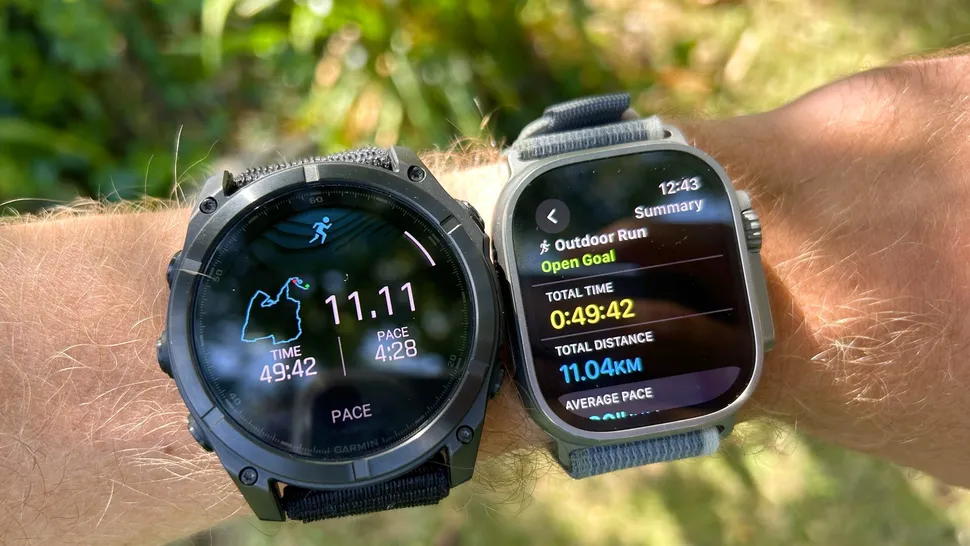
Most athletes do not need a watch that flatters them. They need one that tells the truth. For serious American athletes, the Garmin versus Apple Watch choice usually comes down to training depth against daily-life ease. Garmin wins for long-range endurance training, outdoor navigation, battery life, and sport-first planning. Apple’s side wins when you want a sharp iPhone companion that also tracks hard workouts, handles calls, supports apps, and feels natural outside the gym. The harder question is not which brand is “better.” It is which one will still help at mile 18, lap 70, or 5 a.m. when the plan says tempo but your legs say no. Readers who follow serious sports coverage already know the best gear is not always the flashiest gear. It is the gear that makes better decisions easier. If your training week includes marathons, triathlon blocks, trail routes, back-to-back rides, or structured recovery, Garmin has the edge. If your sport life is tied to texts, music, safety, and iPhone habits, Apple’s wearable keeps the fight closer than old-school runners admit.
Garmin Wins When Training Comes Before Everything Else
Garmin feels like it was built by people who expect the workout to be the center of the day, not one app among many. That matters when you are chasing a Boston qualifier, building toward a half-Ironman, or managing a high school cross-country season while still working a full-time job. The watch does not ask you to become a data scientist. It gives you a training picture that grows more useful as your weeks stack up. The tension is simple: serious athletes want numbers, but they also want fewer guesses. Garmin is not perfect, yet its best models turn messy training patterns into signals you can act on.
Why endurance athletes trust the training screen
A long run does not end when you press save. That is when the real question starts: did the session move you forward, or did it steal from tomorrow? Garmin’s advantage is the way it connects fatigue, load, recovery, and trend lines without making you hunt across scattered apps. On a Forerunner 970, Garmin lists up to 15 days in smartwatch mode and up to 26 hours in GPS-only mode, which gives runners enough room for travel days, workouts, and sleep tracking without constant charging anxiety.
That space changes behavior. A runner training in Chicago in February can record intervals on Tuesday, strength on Wednesday, an easy run on Thursday, and a snowy long run on Saturday while still reviewing sleep and recovery each morning. You stop treating battery life as a chore. That sounds small until you miss overnight recovery data because your watch was on a charger instead of your wrist.
The non-obvious part is that Garmin’s best value is not one magic score. It is the pressure it removes from the athlete. When training metrics line up with how your body feels, you gain confidence. When they disagree, they force a better question. Did you sleep badly? Did heat push your heart rate up? Did yesterday’s “easy” group run turn into a race?
That last question matters because amateur athletes often ruin a plan in ordinary ways. They run too hard with friends, lift heavy too close to speed day, or ignore a bad sleep block because the calendar looks neat. Garmin cannot make the choice for you, but it gives the choice more friction. That is useful. A tiny pause before one foolish session can save two weeks.
The best sports watch is the one you forget during hard sessions
A sports watch has to disappear when the work gets ugly. Buttons matter here. Touchscreens look clean at a desk, but sweat, rain, gloves, sunscreen, and cold fingers punish clean design. Garmin’s button-led control system still makes sense for athletes who train outside in rough weather.
Think about a Colorado trail runner dropping into a rocky descent. A screen swipe is not the move. A raised button press is. The same idea applies to pool intervals, winter runs in Boston, and century rides where your hands are on the bars and your brain is already busy.
Garmin’s deeper models also fit more sports without feeling like each one was added as a side note. Running, cycling, swimming, triathlon, hiking, skiing, strength, and rucking all get meaningful attention. The result is not a prettier watch. It is a calmer one. It shows up, records, guides, and gets out of the way.
This is why many coaches still like Garmin for athletes who need repeatable sessions. A workout can be built, sent, followed, and reviewed with less drama. The watch face is not trying to win your attention from the interval. It wants you to hit the split, recover, and keep moving. During hard training, that quiet attitude becomes a feature.
Where Apple Watch Still Pulls Athletes Away From Garmin
The easy take is that Apple’s wearable is for casual fitness. That take is old. The Ultra 3 now claims up to 42 hours of normal use, up to 72 hours in Low Power Mode, and 20 hours of continuous outdoor workout tracking in Low Power Mode with full GPS and heart-rate readings. That is not Garmin-level freedom, but it is enough for many serious runners, cyclists, rowers, and gym athletes who do not train beyond a day at a time.
The appeal is not only fitness. It is the whole day. Calls, messages, payments, music, maps, safety tools, and health alerts all live on the wrist in a way that feels smooth for iPhone users. Serious athletes are still people with jobs, kids, traffic, errands, and late meetings. A device that handles training and daily friction earns a real place.
Smart features can protect a training week
Athletes often pretend smart features are distractions. Sometimes they are. But a watch that helps you leave the phone at home can protect the workout. If you can take an urgent call, stream audio, pay for water, or message your partner after a delayed run, you are more likely to complete the session without carrying extra gear.
This is where Apple’s side is strong. Ultra 3 includes dual-frequency GPS, advanced workout metrics, Custom Workouts, Training Load, and 5G support on cellular models, while staying tied to the iPhone experience many Americans already use every hour.
The counterintuitive point: smarter can mean simpler. For a parent squeezing a six-mile progression run between school pickup and a work call, fewer pocket items can matter more than another recovery chart. Garmin may coach the athlete better. Apple may fit the person better.
There is also a safety layer that serious athletes should not mock. Running alone before sunrise, cycling after work, or walking back from a trailhead can expose you to risks that have nothing to do with pace. A watch that can connect, call, pay, and share location can turn a marginal training window into a usable one. More completed workouts may beat more perfect data.
Health tracking matters when sport is not the only priority
A serious athlete does not live in a lab. Stress, sleep, work travel, heat, alcohol, allergies, and poor meals all show up in training. Apple has leaned hard into health alerts and daily wellness, while watchOS now includes training load views that show recent workload by workout type.
That makes Apple’s wearable a better fit for athletes who care as much about health context as training prescription. A masters runner in Dallas may want heart-rate alerts, fall detection, sleep trends, and easy communication more than a dense performance dashboard. The right choice depends on fear as much as ambition. Some athletes fear undertraining. Others fear missing warning signs.
The weakness is that Apple still depends on charging habits and, for many deeper athlete tools, third-party apps. That is not a deal breaker. It does mean you may build your own training stack rather than getting a complete one from the first boot.
For some athletes, that freedom is a gift. You can pick the run app you like, pair it with a strength app, add a nutrition tracker, and keep the watch face simple. For others, it becomes homework. If you already ignore half your phone apps, a scattered watch system may not turn you into a disciplined planner.
Battery Life, GPS, and Recovery Decide the Winner After Week Three
The first week with any premium wearable is fun. Bright screen, new faces, clean graphs, a few proud screenshots. Week three tells the truth. By then, the novelty fades and the routine takes over. You either trust the device enough to wear it all day and all night, or you start making compromises. For serious athletes, the winner is often the watch that collects the cleanest record with the least babysitting.
Battery life is not only about race day
Battery life gets framed around ultra races, but that is too narrow. A watch with long runtime captures normal life better because it spends less time off the wrist. That improves sleep tracking, resting heart-rate trends, HRV patterns, and recovery estimates. Missing a night here and there may not ruin anything. Missing them every week weakens the story.
Garmin’s fēnix 8 family shows why outdoor athletes still favor the brand. Garmin lists max battery GPS mode figures that rise across sizes, with up to 49, 81, or 145 hours depending on model and settings. Expedition GPS mode stretches longer for trips where breadcrumb tracking matters more than constant detail.
A backpacker in Utah, a gravel rider in rural Kansas, or a marathoner traveling for a race weekend all benefit from fewer charging decisions. The hidden win is mental. You can pack shoes, gels, layers, and a charger without making the charger the center of the plan.
Charging also shapes sleep data. A watch that needs a daily top-off often gets removed during dinner, showering, or bedtime. That is exactly when recovery data can vanish. The athlete then sees a clean chart with dirty gaps. Long battery life does not make you faster by itself. It makes the record more complete, which makes later decisions less shaky.
GPS accuracy needs context, not worship
Dual-frequency GPS has become a marketing badge, but athletes should think about where they train. If you run under Manhattan buildings, ride through tree cover in the Pacific Northwest, or race on twisty urban courses, GPS quality matters. If most of your runs are open-road loops in Phoenix, you may never notice the same gap.
Apple has closed much of the old distance. Ultra 3 lists L1 and L5 precision dual-frequency GPS across major satellite systems, and Garmin’s top watches also offer multi-band GNSS modes. The fight is no longer “one has GPS and one is a toy.” It is about how each watch handles hard environments, battery drain, maps, and post-workout review.
Here is the practical test: do not judge GPS by one perfect Saturday run. Judge it by the ugly route. Downtown turns. Wet tree cover. A race start with thousands of watches waking at once. If a device keeps pace and distance believable there, it deserves trust.
Maps add another layer. A clean pace graph helps after the workout, but a good on-wrist route can rescue the workout while it is happening. Trail athletes, gravel riders, and hikers need more than a line afterward. They need confidence at the fork before the wrong turn costs daylight.
Choose by Sport, Not by Brand Loyalty
Brand loyalty is where good buying decisions go to die. Serious athletes should start with sport, training load, terrain, and daily habits. A runner chasing a PR needs a different tool than a CrossFit athlete who wants calls and music. A triathlete needs smooth sport switching. A hiker needs maps and battery. A recreational soccer player may need comfort and health tracking more than advanced intervals. The winner changes when the athlete changes.
Runners and triathletes should weigh training metrics first
If your week has structured runs, threshold sessions, long rides, swim sets, brick workouts, and planned recovery, Garmin is the safer pick. Its athlete-first layout gives you more native structure with less app shopping. Running dynamics on the Forerunner line can show form-related data such as cadence and other metrics, with some fields requiring compatible accessories for full detail.
That matters for people who review sessions with intent. A triathlete in San Diego might compare bike load against run fatigue before deciding whether Sunday should be aerobic or off. A college runner might notice that easy-day heart rate rises after poor sleep and adjust before a small ache becomes a long break.
The marathon training mistakes checklist belongs next to this decision because many athletes buy watches to fix planning errors that are not watch problems. No wearable saves a bad plan. The best device helps you spot the bad plan sooner.
Triathlon also exposes clumsy design fast. Open-water swim, transition, bike, transition, run: the watch has to follow without begging for attention. Garmin’s history in multisport shows here. You can feel the difference between a device that treats triathlon as a main sport and one that can be shaped into it with patience.
Gym athletes, hybrid users, and iPhone loyalists have a closer call
Not every serious athlete is an endurance athlete. Some train for strength, pickleball, rowing, basketball, HIIT, or general conditioning. For them, the difference narrows. Apple’s wearable may be the better all-day tool because it blends health tracking, smart features, and workout capture with fewer lifestyle tradeoffs.
A New York gym-goer who lifts four days a week, runs twice, and tracks sleep may care more about comfort, app choice, and phone-free convenience than topo maps. That athlete should not feel guilty choosing Apple’s side. The best watch is not the one an ultrarunner respects. It is the one that stays on your wrist.
Still, athletes who want a deeper heart rate zone guide and training calendar should be honest about app dependence. Apple can get there, but Garmin starts closer to that world. Fewer add-ons. Fewer decisions. More native sport logic.
Hybrid athletes should also think about social pressure. If every friend shares rings, texts from the wrist, and uses the same phone features, Apple’s side may keep you engaged. If your training friends trade route files, race predictions, and recovery scores, Garmin may pull you deeper into useful habits. Community is not a spec, but it affects follow-through.
Conclusion
The winner is clearer when you stop asking which brand has the better watch and start asking which one protects your training decisions. Garmin is the better pick for most serious endurance athletes because it gives longer battery life, richer native training metrics, stronger outdoor tools, and a sport-first feel that holds up when weeks get heavy. Apple’s side remains the better pick for iPhone users who want one wrist device for workouts, health, safety, music, calls, and daily flow. The right Garmin or Apple Watch choice should match your weak point. If you miss data because you forget to charge, choose Garmin. If you miss workouts because carrying a phone and managing life gets messy, Apple may keep you more consistent. Serious athletes love numbers, but consistency still beats decoration. Buy the watch that makes the next good session easier, then let the training prove the purchase.
Frequently Asked Questions
Is Garmin better than Apple for marathon training?
Garmin is usually better for marathon training because its native tools focus on load, recovery, pacing, GPS, and long battery life. Apple can work well with added apps, but Garmin gives runners more structure from the start.
Which wearable has better battery life for athletes?
Garmin usually wins battery life, especially on Forerunner, fēnix, Enduro, and adventure models. Apple’s Ultra line lasts far longer than older models, but Garmin still gives endurance athletes more room for long events and sleep tracking.
Do serious runners need dual-frequency GPS?
Dual-frequency GPS helps most in cities, forests, mountains, and crowded races. Open-road runners may notice less difference. It is worth having if pace, distance, and race review matter to your training.
Is Apple good enough for triathlon training?
Apple can handle triathlon training for many athletes, especially with strong third-party apps. Garmin remains the cleaner choice for native multisport tracking, longer sessions, deeper recovery views, and less setup before race day.
Which watch is best for strength training and gym workouts?
Apple’s wearable often fits gym users better because it handles music, calls, apps, and quick workout tracking smoothly. Garmin is better if strength work supports a larger endurance plan with recovery and training load.
Can Garmin work well with an iPhone?
Yes, Garmin works with iPhones through Garmin Connect, notifications, health syncing, and app settings. It will not feel as tightly tied to iOS as Apple’s own device, but the sports tools remain strong.
Should beginners buy Garmin or Apple first?
Beginners should choose based on habits. Pick Garmin if you want coaching, running structure, and long battery life. Pick Apple if you want a friendly daily watch that also makes starting workouts easy.
What matters more, smart features or training metrics?
Training metrics matter more when you follow a plan and review progress weekly. Smart features matter more when convenience helps you train consistently. The best choice is the one that removes your biggest barrier.